
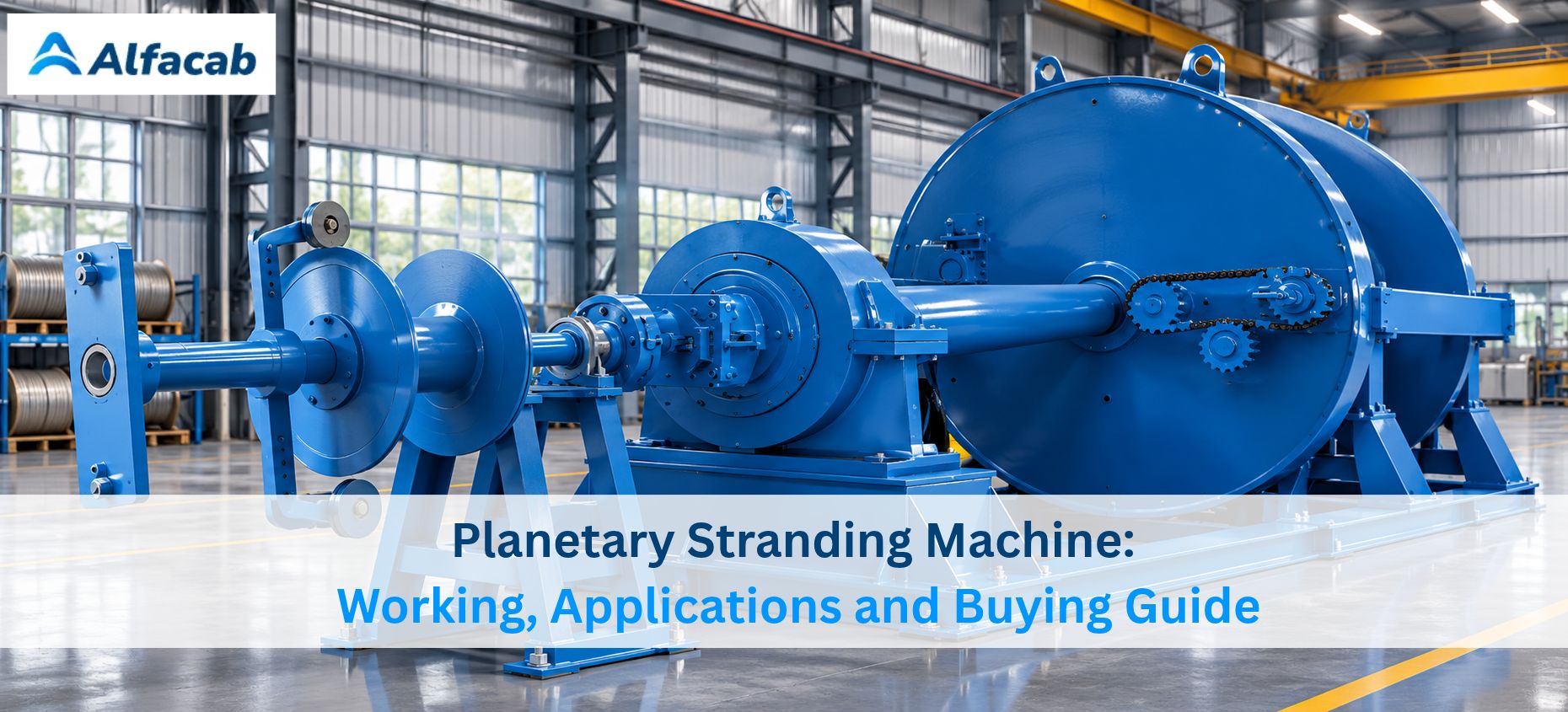
Cable makers who produce heavy conductors or large-section constructions often reach a point where a simple stranding machine is no longer enough. That is where a planetary stranding machine becomes relevant. It is designed to handle larger bobbins and heavier loads while keeping the stranding process stable and controlled. In this guide, we explain what a planetary stranding machine is, how it works, where it is used, and what to check before you buy one from a manufacturer in India.
What Is a Planetary Stranding Machine?
A planetary stranding machine is a stranding machine in which wire bobbins are carried in cradles on a rotating frame. As the frame turns, the bobbins travel around the central axis of the machine, much like planets moving around a sun, and the wires are laid helically around a central core wire or conductor. The result is a stranded conductor with a consistent, concentric construction.
Compared with lighter stranding equipment, planetary machines are usually chosen when the conductor is heavy, the bobbins are large, or the construction needs steady control during stranding. Exact capacities and configurations vary between models, so always confirm them against the manufacturer's specifications.
How a Planetary Stranding Machine Works
The process begins with loaded bobbins sitting in the cradles of the rotating frame. Each bobbin pays out wire towards a closing die, where the wires come together around the central core. As the frame rotates, the wires are laid in a helical pattern. A take-up unit then pulls the finished strand forward and winds it onto a reel or drum.
Lay length depends on the relationship between the rotation of the stranding frame and the speed at which the strand moves forward. A shorter lay gives a tighter twist, while a longer lay gives a more open one. Our guide to stranding machine lay length explains how to calculate and control it.
In planetary designs, the cradles are arranged so that the way each wire is twisted can be controlled, depending on the machine configuration. This matters for constructions where torsion in the wire needs to be managed, so ask the manufacturer which options the machine offers.
Key Features to Look For
When you compare machines, look beyond the name and check these points.
- Bobbin capacity: the size and weight of bobbins the cradles can hold, since this decides how long a run you get between loadings.
- Number of cradles: this sets the wire counts you can strand in one pass.
- Conductor range: the smallest and largest conductor sizes and wire diameters the machine can handle.
- Drive and speed control: smooth, stable control of rotation and take-up speed so the lay length stays consistent.
- Pay-off and take-up compatibility: matching units that suit your reel sizes and line speed.
- Safety and guarding: proper guards and interlocks around the rotating frame.
- Ease of loading and maintenance: access for bobbin changes, lubrication and routine checks.
Applications of Planetary Stranding Machines
Planetary stranding machines are generally used where heavier or larger-section conductors are made. Typical areas include power cable conductors, overhead conductors made from aluminium or other wires, and large stranded constructions for industrial cables. They may also be used for other stranding duties, depending on how the machine is configured.
Because the right choice depends on your wire size, number of wires, and output target, share your cable specification with the manufacturer before deciding. A good supplier will ask about these details first rather than quoting a machine straight away.
Planetary vs Other Stranding Machines
Each stranding machine type suits a different job, and the best one depends on your product.
- Rigid stranders are commonly used for heavier stranded conductors. See our guide on what a rigid stranding machine is.
- Tubular and skip stranders are built for high-speed production of lighter conductors. Our comparison of skip and tubular stranders explains the difference.
- Planetary stranders suit heavier loads and larger bobbins, with controlled stranding for bigger constructions.
Do not choose by name alone. Compare conductor size, wire count, speed, bobbin size, and the take-up arrangement before you decide. If you are unsure which type fits, a short conversation with the manufacturer's technical team can save you from buying a machine that is too small or too complex for your needs.
How to Choose a Planetary Stranding Machine Manufacturer in India
The machine is only as good as the company behind it. Use this checklist when you compare suppliers.
- Experience: how long has the company built stranding machinery, and can it show installations?
- Customisation: can the machine be configured for your conductor sizes and materials?
- Technical guidance: will the team help you plan the line, not just sell the machine?
- Clear specifications: are speeds, capacities, and power needs documented?
- Installation and training: is commissioning support and operator training included?
- After-sales service: how quickly can you get spares and service?
You can also read our overall cable manufacturing machine price guide to understand what influences cost.
Talk to AlfaCab Industries About Your Stranding Requirements
AlfaCab Industry, based in GIDC Vapi, manufactures stranding machines for cable and conductor makers across India. If you are planning a new line or upgrading an existing one, our team can discuss your conductor sizes, output, and budget and suggest a suitable configuration. Explore the Planetary Stranding Machine page or contact us for a quote.
